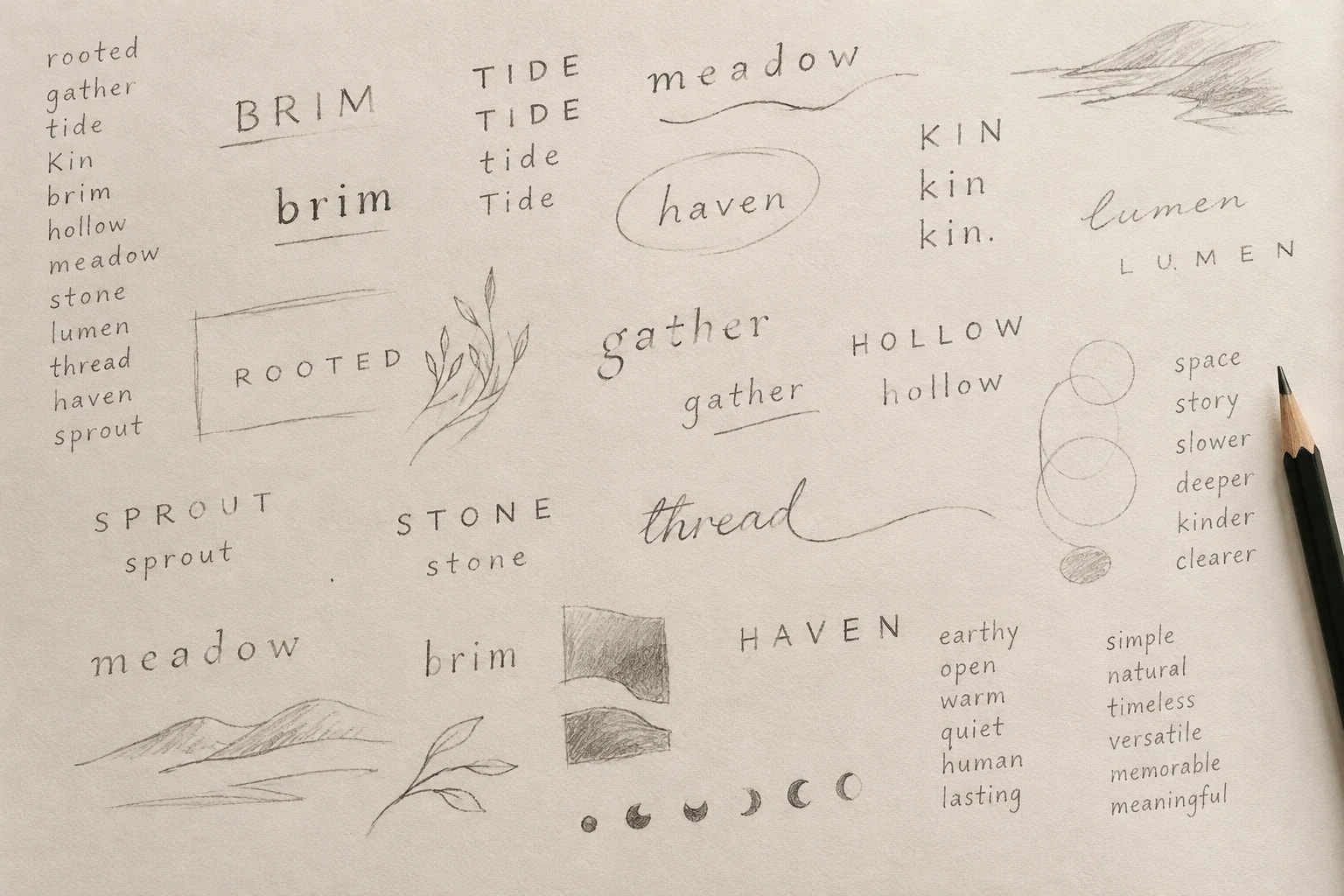
A company name in English makes sense for businesses that sell abroad, launch an online service or work with foreign partners. Below we look at when such a name works better than a Ukrainian one, six techniques for coming up with it, examples of Ukrainian companies, and the checks to run before entering a new market.
When a company needs an English name
An English company name pays off when your customers and partners read English: in export, in online services and IT, in work with foreign clients. Such a name does not need translating, people find it in search abroad, and it can be registered as a trademark in the markets where you sell. A Ukrainian name suits a local business better: a coffee shop, a clinic or a service in one city, where people search for and remember the name in their native language. Do you work in Ukraine today but plan to enter Poland or the US in 2-3 years? Then it is better to choose a name for those markets right away, because changing it later will affect the domain, the trademark, the sign and everything customers already remember. The decision depends on the market and on the language your brand's target audience thinks in.
| Criterion | English name | Ukrainian name |
|---|---|---|
| Market and customers | Export, IT, foreign partners | A local service or shop, buyers in Ukraine |
| How memorable it is for a local audience | Lower if people do not read English | Higher, the name is clear on first reading |
| Domain and search abroad | A .com works, people search for the name without transliteration | People type the Latin spelling in different ways |
| Trademark registration abroad | One spelling for all countries | Foreign markets need an extra Latin version |
| Sign and documents in Ukraine | The legal entity still gets a Ukrainian name | One name on the sign, in documents and in ads |
What makes a good name in English
A name is good when it is easy to read and remember. How it sounds matters less than how it connects to the company. Check your options against five criteria:
- Short. 1-2 words that fit into a logo and a website address. People will shorten a long name in conversation anyway, and not always the way the brand would like.
- Reads the same on paper and by ear. Someone who heard the name on the phone or in a podcast should be able to type it into search without help. For online services that customers find through search, this is the main thing.
- Connected to the field or the brand image. It can be a direct description of the service or a metaphor that hints at how you are useful. The word cube in Petcube, for example, describes the shape of the device.
- Unlike competitors. If the niche already has five companies with smart or pro in the name, customers will confuse the sixth with the rest.
- No second meaning. In the languages of your market the word has no slang, rude or funny meaning that will surface in the very first review.
6 naming techniques in English
Naming in English rests on six techniques, and they are also how good company names in English are made. The techniques can be combined, but each has its own risk.
Take an existing English word
A ready word from the dictionary carries an image right away: Apple means the fruit, Puma names a wild cat. The buyer needs no explanation, and the designer can easily find a symbol for the logo. The downside is that good short words in popular niches have long been registered as trademarks. Besides, many words have a second, slang meaning that a native speaker knows and an ordinary dictionary will not show. When the word you want is taken, you add a second part to it or change a letter, and those are the next techniques. Another option is a rare word from botany, geography or mythology, since such words appear less often among trademarks.
Join two words
Two words merged into one or placed side by side give a name that is clear and at the same time less common: Facebook is built from face and book, YouTube from you and tube. There are far more such combinations than single words in the dictionary, so it is easier to find a free one. Pairs where one word names an object and the other a quality or an action work well. Watch the length, three words are already hard to remember, and watch for an accidental reference to a famous phrase, film or song that will pull the brand's meaning off course. Before choosing a pair, say it out loud: there should be no awkward cluster of consonants where the words meet.
Build a new word from parts
In naming, a neologism is a new word built from parts of other words. That is how Microsoft came about: according to the company, the name was made from microprocessors and software, and the spelling Micro-soft first appears in a letter from Bill Gates to Paul Allen dated July 29, 1975. A neologism has the best chance of a free domain and trademark. Check two things: that the new word does not match an existing word with an unrelated meaning, and that it is easy to read without help. Such a name gets its meaning from the brand, so a recognizable root inside it helps. Start with roots that describe the service and try different combinations.
Shorten it to an abbreviation
An abbreviation is made of the first letters of several words. IKEA, as the company itself explains, stands for the initials of its founder Ingvar Kamprad, the Elmtaryd farm and the village of Agunnaryd, and the name appeared in 1943. KFC is short for Kentucky Fried Chicken. The letters should be easy to pronounce together, and the full form is handy to give in a slogan. On their own, letters say nothing about the company until the brand becomes well known, and combinations of 2-3 letters are already taken in many niches. Before choosing an abbreviation, read it out loud letter by letter: if it sounds like someone else's abbreviation, people will confuse them.
Name it after a surname or a place
A founder's surname or the name of a place makes a name personal: Ford carries the surname of Henry Ford, and Adobe, according to the company itself, was named after Adobe Creek, which ran behind co-founder John Warnock's house. Behind a surname stands a real person, and their story is easy to believe. Check how a foreigner will read and pronounce your surname. A place carries another risk: the name of a city or district can tie the brand to one region once the company grows. The surnames of two founders are sometimes joined, but such a brand name quickly becomes long.
Write a Ukrainian word in Latin letters
A Ukrainian word or name written in Latin letters keeps the local flavor and can still be read abroad. That is what Hoverla Soft from Lviv did, taking the name of Ukraine's highest mountain. The technique works if the word is short and has no difficult sounds. Under the official transliteration approved by the Cabinet of Ministers in 2010, ж is written as zh, х as kh, ц as ts, щ as shch, and ї at the start of a word as yi, and foreigners find such combinations hard to read. Before choosing, write the word in three or four ways and ask a foreigner which version they read correctly.
Examples: Ukrainian companies with English names
If you are looking for examples of company names in English, it is handy to take them from Ukrainian companies that have worked in foreign markets from day one. Here is how the names of six of them are built and which technique from the list above the founders used:
| Company | What it does | How the name is built | Technique from the article |
|---|---|---|---|
| Grammarly | An assistant for writing in English, founded in 2009 | The word grammar and the suffix -ly, the founders chose the new name when the online editor started to pay off | A new word from parts |
| Readdle | Apps for documents, founded in 2007 in Odesa | The word read with the double letters that were fashionable at the time, the first product was a document reader | A new word from parts |
| Petcube | Cameras for watching pets at home | Pet and cube: a co-founder described the device as a small cube, and at first the project was called Rocki after the inventor's dog | Two words |
| Reface | An app for swapping faces in videos | Re and face: a co-founder liked that it is a verb, like to google, and the name Doublicat did not last long | Two words |
| Jooble | Job search, founded in 2006 | A reworked name of the Google search engine, as the founders told Forbes Ukraine | A new word from parts |
| Hoverla Soft | Software development, Lviv | The name of Hoverla, Ukraine's highest mountain, in Latin letters plus the word soft (software) | Latin letters |
International naming: how to check a name before going abroad
International naming is checked before the company is registered and the logo is ordered, because after launch a name change will affect the domain, the sign, the packaging and customer habits, while links and reviews will stay under the old name.
What the word means in other languages
The word is checked for slang, rude meanings and sound-alikes in all the languages of the markets the business is entering. An ordinary dictionary is not enough for this: slang changes fast, so people look at slang dictionaries and ask native speakers, preferably several from different countries. Tell the native speaker right away that this is a company name and what field it is from, otherwise they will judge the word without context. Separately, check whether the name sounds like an obscene word or a well-known competitor when said quickly. It is handy to put the answers in a table: option, language, what the native speaker heard. With several markets, repeat the check for each language.
How people pronounce it and write it down by ear
A simple listening test: say the name out loud and ask a person to write it down. This shows where the stress, double letters or English letter combinations that are read differently from how they are spelled trip people up. The creators of Reface said in an interview that they temporarily renamed the app Doublicat, after which investors could not pronounce the name, and in the App Store people searched for it as dublikat. In the end they went back to Reface. Repeat the test with people from different countries: an English speaker and a Pole will read the same combination of letters differently.
Are the domain and trademark free
The domain and trademark are checked together, otherwise you may end up with a name you cannot protect. The order is as follows:
- Search for the name in Google and on social media: is there a company with the same or a similar name in your niche and in the countries you are entering? Look through at least the first two pages of results.
- Check the .com domain and the domain zones of the countries where you will sell, as well as free account names on social media. If the .com is taken, find out whether a website runs there and what the owner does.
- Search for the trademark in the WIPO Global Brand Database, in TMview, which collects trademarks from EU offices and many other countries, in the Trademark Search system of the US office (USPTO) and in the database of the Ukrainian IP office (UANIPIO).
- Decide how to register the trademark abroad. The WIPO Madrid System unites 117 members, and one application in it covers up to 133 countries, the second option is a separate application in each country. Check registration times and costs with a patent attorney.
How to choose one name out of several
It is easier to choose from a shortlist of 3-5 options. Rate each against the five criteria of a good name and show them to people from your target audience, including foreigners if you are entering their market. Ask what they expect from a company with that name: the answers will show whether the name matches the brand's positioning. Then look at how the name works in the logo, on the website and in the visual identity, and keep the one that passed all the checks. A week later, ask the same people which brand name they remember without a prompt.
Good company names in English come out when the sound is backed by checks of meaning, pronunciation, domain and trademark, and the choice is made together with the people the brand is created for. The stages of the work are described in the article all about naming a business and a brand, and naming is convenient to order together with the next step, logo design.