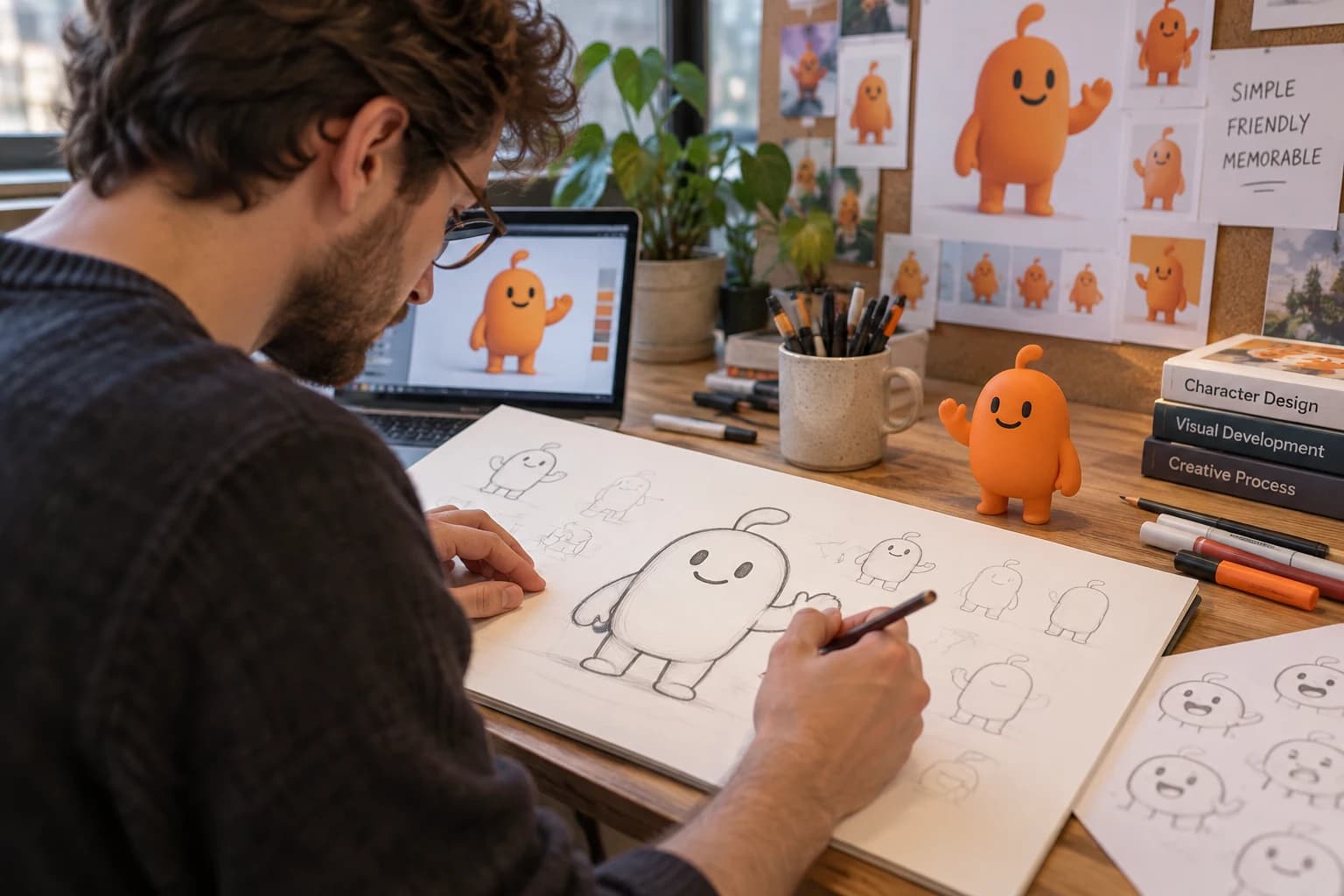
Illustration is an image created for a specific purpose: to explain an idea, show a product, set the tone of a page or package, or make a message more memorable. It is always tied to a text, a brand, or a product, which is exactly what separates it from an independent drawing or a free artistic work.
Below we explain how it differs from a sketch or photo, why businesses use it, and which types and styles exist.
What does “illustration” mean?
It is a drawn image that works together with the content and explains it faster than a paragraph of text.
The word comes from Latin: illustrare meant “to illuminate” or “to clarify.” In the beginning, it was about visual explanation. The meaning of “image in the text” became standard in the early 19th century.
The simplest example is familiar to everyone: an instruction for a device shows which part to insert into which slot. The same principle works in business, except the “part” is the customer benefit and the “technical description” is the brand narrative.
How is it different from a drawing or photo?
A person may say “draw a picture,” but they usually mean three different things, even though the difference is mainly in the task and the context.
Criterion
Illustration
Drawing or photo
What it is for
To explain or sell a specific thing
To express the author’s idea or capture a scene
What it is tied to
A text, product, or brand
It exists on its own
Who sets the task
The client through a brief
The artist or the circumstances of the shoot
Photos are used when the object already exists; illustration is used when there is no real photo or the visual needs to be shaped intentionally.
Why do businesses need illustration?
Illustration solves tasks that photography cannot handle well, or handles much more expensively. Here are the most common ones.
- Explain something complex
- A process or system can be understood in a second without reading a long paragraph.
- Stand out from competitors
- Stock photos are easy to recognize and often used by several brands at once.
- Show what does not yet exist
- A future product, an internal process, or an abstract benefit.
- Keep a consistent style
- A website and packaging look like the same brand, not separate projects.
- Give the brand a face
- A character becomes a familiar presence that people recognize in packaging, email, and ads even without the company name nearby.
The last point is especially powerful. A corporate hero behaves like a familiar character and stays in memory across different touchpoints.
Where companies use it
- Website and banners
- The first screen, service cards, empty cart state, 404 page.
- Packaging and labels
- The graphics matter almost as much as the text.
- Presentations
- A slide with a diagram reads faster than a table.
- Social media
- A visual series can be identified in the feed before the brand name appears.
- Advertising layouts
- Outdoor ads, print, and digital banners.
- Identity systems
- Patterns and icons become part of the brand style along with the palette and fonts.
The order matters. First, the style and the rules for its use are fixed together with the brand identity, and only then do designers create visuals for each touchpoint. Otherwise the website, the box, and the presentation start to look like work by different studios.
The format depends on the task. For print, a PDF with bleeds and outlined text is often prepared; for screens, a lighter file is used.
Types of illustration
Illustrations are divided by the method of creation, and the designer chooses the format based on how the file will be used later.
- Vector
- SVG and PDF, scalable without losing sharpness.
- Raster
- Built from pixels, great for texture but limited in scale.
- Digital
- Drawn on a tablet; this is how most web graphics are created.
- Hand-drawn
- Pencil or watercolor, then scanned.
- 3D
- Useful for showing a product from multiple angles.
Book and scientific graphics are often separated into their own category, because they require precision and technical correctness rather than a distinctive style.
Styles and techniques
A designer chooses the style based on the task, not on fashion.
- Flat
- Simple shapes without shadows; readable even at 24px.
- Linear
- Thin contours; works well for icons and diagrams.
- Isometric
- Shows a process or system in a complete view from above and from an angle.
- Collage
- Mixes photography and graphic elements.
- Realistic
- Shows the product accurately; often used on packaging.
One style is usually chosen for the whole brand. Mixing flat and realistic styles is possible, but only when the boundary is clearly defined.
How we work on a brand image
#### Consultation and brief
The client describes the task, shows references, and points out important details.
#### Brainstorm
The team develops associative ideas and visual directions.
#### Sketches
The designer presents several options based on the brief.
#### Refinement
The chosen direction is approved and worked out in detail.
#### File delivery
The final layouts are prepared and handed over.
Sketches are shown before the final illustration, because corrections are cheap at that stage. After final approval, reworking means almost the same amount of work as starting from scratch, so the key decisions should be settled early.
Frequently asked questions
What is illustration in simple words?
It is an image created for a specific place and a specific idea. The artist is not choosing the theme freely; the brief defines the task. The same technique can produce both a commercial illustration and a free artwork — the difference is in who defined the purpose.
How is it different from a drawing?
A drawing can be created for personal expression and does not necessarily belong to a specific place. An illustrator works by a brief and knows where the image will be used: on a website, package, presentation, or ad. The technique may be the same; the difference is in the task and who sets it.
What types are there?
There are vector, raster, digital, hand-drawn, and 3D illustrations. Vector scales without loss of quality, raster adds texture, 3D shows products from different angles, and the choice depends on where the image is published and whether it needs to be enlarged later.
Why is it useful for a business?
To explain something quickly, avoid looking like every competitor using stock photography, and keep a consistent style across the website, packaging, and presentations. Illustration is also useful for showing a product or process that cannot be photographed. It can also become the brand’s corporate character that travels through all the touchpoints.
Conclusion
Illustration is not decoration; it is a tool. It explains, differentiates, and maintains the visual consistency of a brand.
Whether it is a character, a website series, or a comic, illustration can become the visible language of a business. When a company needs a complete system with clear usage rules, the next step is brand development.